Discussion
Loading...

#Tag

  • About
  • Code of conduct
  • Privacy
  • About Bonfire
Jayne :wales_flag:🇪🇺🏳️‍🌈 boosted
Flipboard Science Desk
@ScienceDesk@flipboard.social  ·  activity timestamp 2 days ago

These charcoal-eating fungi flourish after fires. Uncovering their genetic secrets could help rebuild burned ecosystems.

From @Smithsonianmag: https://flip.it/vPPj1B

#Fungi #Ecology #Science #Wildfires #Botany

Smithsonian Magazine

These Charcoal-Eating Fungi Flourish After Fires. Uncovering Their Genetic Secrets Could Help Rebuild Burned Ecosystems

Mycologists cultivated fungi they found in post-wildfire landscapes to understand the evolutionary traits behind their ability to thrive in the wake of flames
  • Copy link
  • Flag this post
  • Block
Jayne :wales_flag:🇪🇺🏳️‍🌈 boosted
MyceliumMiscellany
@myceliummiscellany@mastodon.social  ·  activity timestamp 2 days ago

Spotted on the lawn - a very tiny galerina, possibly G. hypnorum.

#fungi #mushroom #grass

Sorry, no caption provided by author
  • Copy link
  • Flag this post
  • Block
Jayne :wales_flag:🇪🇺🏳️‍🌈 boosted
MushroomBot
@MushroomBot@regenerate.social  ·  activity timestamp yesterday

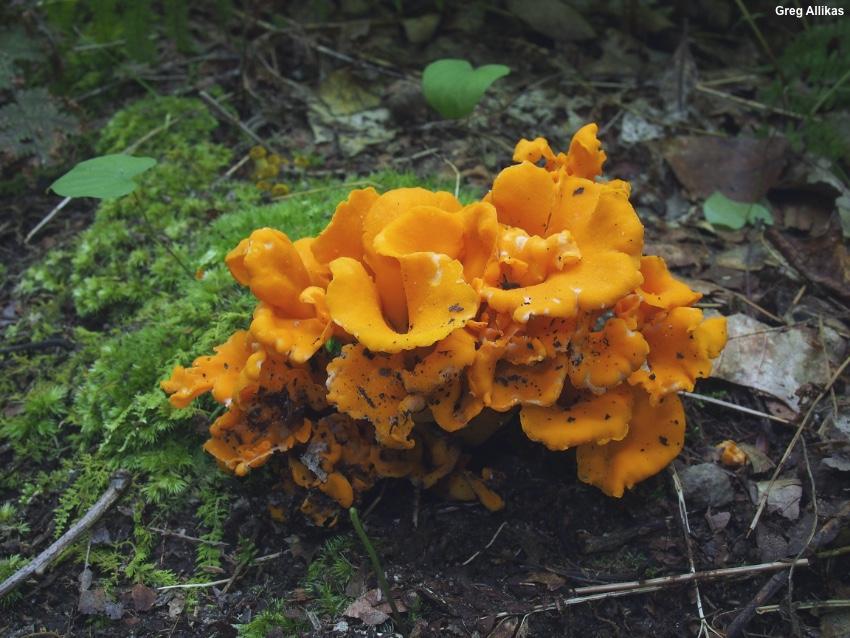
Craterellus odoratus

https://www.mushroomexpert.com/Craterellus_odoratus.html

Ecology: Apparently mycorrhizal; associated with oaks, and perhaps with other hardwoods; growing in clusters; summer and fall; usually collected in the southern Appalachian Mountains (especially southern Ohio and North Carolina) but ranging to Florida and Texas, and into Mexico. The illustrated and described collection is from North Carolina.

Fruiting Body: A cluster of individual fruiting bodies packed tightly together or joined at the stem bases. Individual caps 3-8 cm high; 1-3 cm wide; vase-shaped, without a clearly defined cap and stem.

Upper/Inner Surface: Medium yellowish orange; bald or very finely scurfy; the margin wavy.

Under/Outer Surface: Pale yellowish orange; bald; smooth; darker toward the base; bruising darker where handled; basal mycelium darker yellow-orange.

Flesh: Thin and brittle; white to yellowish orange.

Odor and Taste: Not distinctive.

Spore Print: Not recorded.

Microscopic Features: Spores 8-10 x 4.5-6 ; subellipsoid; smooth; hyaline in KOH. Basidia 40-50 m long; 2- and 4-sterigmate. Hymenial cystidia not found. Elements of upper surface forming a trichoderm; cylindric; septate; hyaline to yellowish in KOH; 2-7 m wide; terminal cells with rounded or subclavate apices. Clamp connections not found.

#mushrooms #fungi #mycology #shrooms #mushtodon #sporespondence #floraspondence

Craterellus odoratus mushroom image.
  • Copy link
  • Flag this post
  • Block
MushroomBot
@MushroomBot@regenerate.social  ·  activity timestamp yesterday

Craterellus odoratus

https://www.mushroomexpert.com/Craterellus_odoratus.html

Ecology: Apparently mycorrhizal; associated with oaks, and perhaps with other hardwoods; growing in clusters; summer and fall; usually collected in the southern Appalachian Mountains (especially southern Ohio and North Carolina) but ranging to Florida and Texas, and into Mexico. The illustrated and described collection is from North Carolina.

Fruiting Body: A cluster of individual fruiting bodies packed tightly together or joined at the stem bases. Individual caps 3-8 cm high; 1-3 cm wide; vase-shaped, without a clearly defined cap and stem.

Upper/Inner Surface: Medium yellowish orange; bald or very finely scurfy; the margin wavy.

Under/Outer Surface: Pale yellowish orange; bald; smooth; darker toward the base; bruising darker where handled; basal mycelium darker yellow-orange.

Flesh: Thin and brittle; white to yellowish orange.

Odor and Taste: Not distinctive.

Spore Print: Not recorded.

Microscopic Features: Spores 8-10 x 4.5-6 ; subellipsoid; smooth; hyaline in KOH. Basidia 40-50 m long; 2- and 4-sterigmate. Hymenial cystidia not found. Elements of upper surface forming a trichoderm; cylindric; septate; hyaline to yellowish in KOH; 2-7 m wide; terminal cells with rounded or subclavate apices. Clamp connections not found.

#mushrooms #fungi #mycology #shrooms #mushtodon #sporespondence #floraspondence

Craterellus odoratus mushroom image.
  • Copy link
  • Flag this post
  • Block
Flipboard Science Desk
@ScienceDesk@flipboard.social  ·  activity timestamp 2 days ago

These charcoal-eating fungi flourish after fires. Uncovering their genetic secrets could help rebuild burned ecosystems.

From @Smithsonianmag: https://flip.it/vPPj1B

#Fungi #Ecology #Science #Wildfires #Botany

Smithsonian Magazine

These Charcoal-Eating Fungi Flourish After Fires. Uncovering Their Genetic Secrets Could Help Rebuild Burned Ecosystems

Mycologists cultivated fungi they found in post-wildfire landscapes to understand the evolutionary traits behind their ability to thrive in the wake of flames
  • Copy link
  • Flag this post
  • Block
MyceliumMiscellany
@myceliummiscellany@mastodon.social  ·  activity timestamp 2 days ago

Spotted on the lawn - a very tiny galerina, possibly G. hypnorum.

#fungi #mushroom #grass

Sorry, no caption provided by author
  • Copy link
  • Flag this post
  • Block
Log in

Bonfire Dinteg Labs

This is a bonfire demo instance for testing purposes. This is not a production site. There are no backups for now. Data, including profiles may be wiped without notice. No service or other guarantees expressed or implied.

Bonfire Dinteg Labs: About · Code of conduct · Privacy ·
Bonfire social · 1.0.0 no JS en
Automatic federation enabled
  • Explore
  • About
  • Code of Conduct
Home
Login