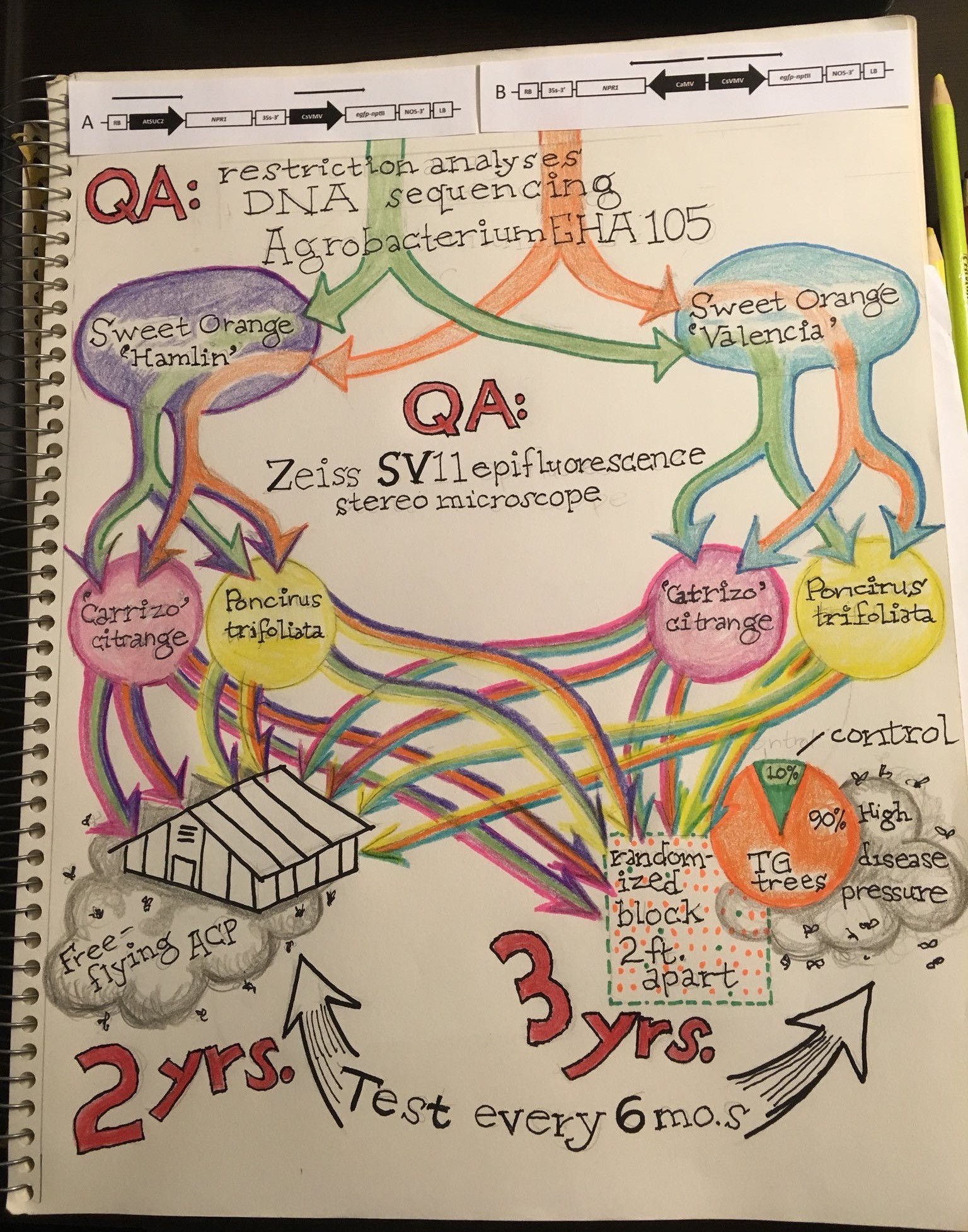
Colored pencil & ink flow chart I made for myself in community college to more easily understand a complex experiment design for a PLOS paper on transgenic citrus. "Transgenic Citrus Expressing an Arabidopsis NPR1 Gene Exhibit Enhanced Resistance against Huanglongbing (HLB; Citrus Greening)". The top has cutout illustrations from the paper itself used as collage. They are schematic representations of the T-DNA vectors used for the study. My drawing then continues to show how the two vectors were used in both 'Valencia' and 'Hamlin' variety oranges. They were then further split into groups that were grafted onto 'Carrizo' citrange rootstock and Poncirus trifoliata rootstock. Groups of those variations and controls were subject to 2 years testing in a greenhouse with free-flying Asian Citrus Psyllids carrying huanglongbing (HLB) or a 3 years planted in a randomized block design of 10% control and 90% transgenic trees in the field in Florida with high HLB disease pressure. In the middle of the flow drawing is a note that there was a check process using a Zeiss SV11 epifluorescence stereo microscope to detect the fluorescent markers showing a successful transgenic change via Agrobacterium EHA 105. The drawing has a very Dr. Seuss block type combined with a typewriter-looking serif lettering. All hand drawn, colored, and lettered, including little drawings of clouds of ACP insects, a field orchard from above, and a pie chart.