The dismissal of the Gemini Earn enforcement action adds to a long list of crypto-focused cases and investigations that the SEC has paused, dismissed, or otherwise ended. That list also includes: Aave [I99], Binance [I85], Coinbase [I78], ConsenSys [I78], Crypto.com [I81], Cumberland DRW [I79], Dragonchain,31 Gemini (a separate investigation) [I78], Hex [I82], Immutable [I80], Kraken [I79], Ondo Finance [I98], OpenSea [I78], PayPal [I83], Ripple [I80], Robinhood [I78], Tron [I78], Uniswap [I78], Yuga Labs [I79], and the ZCash Foundation [I99].
While “but we gave the money back” isn’t normally a successful defense (just ask Sam Bankman-Fried), contributing around $4.4 million to Trump’s campaign,27 donating an undisclosed amount to Trump’s ballroom project,28 spending $1 million to be among the first members of the Trump family-run Executive Branch club,29 investing in Donald Trump Jr.’s American Bitcoin venture,30 and committing $22 million to political projects backing pro-Trump crypto advocates in the midterms seems to have gone a long way. The SEC case was paused back in April [I81], and, as I wrote then, “it’s widely understood that these [pauses] mark the end of SEC scrutiny for these companies.” Two months later, as the Winklevoss twins stood behind Trump in the Oval Office as he signed the GENIUS Act stablecoin bill, Trump remarked about the crypto industry: “I got you guys out of so much trouble”. Thanking the Winklevosses specifically, he added: “They’ve got plenty of cash, and it’s great that you’re on our side.” [I89]
SEC
The SEC has dismissed with prejudice its case against the Winklevoss twins’ Gemini cryptocurrency exchange. Filed in January 2023, the agency alleged that the company had violated securities laws with its Earn program, in which Gemini partnered with the Genesis crypto lender to offer Gemini customers up to 7.4% APY on assets they loaned through Genesis. When Genesis suffered major losses on loans to Three Arrows Capital [W3IGG] and Babel Finance [W3IGG], the company went under, and around $900 million in Gemini customers’ assets were suddenly locked up in bankruptcy proceedings [I17, 18, 42]. Now, the SEC has evidently decided no harm, no foul, stating: “The 100 percent in-kind return of Gemini Earn investors’ crypto assets through the Genesis Bankruptcy and the settlements noted above, and in the exercise of its discretion, the Commission believes the dismissal of the claims against Defendant is appropriate.”26

SEC The SEC has dismissed with prejudice its case against the Winklevoss twins’ Gemini cryptocurrency exchange. Filed in January 2023, the agency alleged that the company had violated securities laws with its Earn program, in which Gemini partnered with the Genesis crypto lender to offer Gemini customers up to 7.4% APY on assets they loaned through Genesis. When Genesis suffered major losses on loans to Three Arrows Capital [W3IGG] and Babel Finance [W3IGG], the company went under, and around $900 million in Gemini customers’ assets were suddenly locked up in bankruptcy proceedings [I17, 18, 42]. Now, the SEC has evidently decided no harm, no foul, stating: “The 100 percent in-kind return of Gemini Earn investors’ crypto assets through the Genesis Bankruptcy and the settlements noted above, and in the exercise of its discretion, the Commission believes the dismissal of the claims against Defendant is appropriate.”26
Rachel E. S. Lösche and 2 others boosted
In Congress
The Senate Agriculture Committee quickly voted to advance its version of crypto market structure legislation to the full Senate. The vote split along party lines, with all 12 Republicans voting in support and 11 Democrats voting against. While all committee Democrats ultimately voted against advancing the bill, pro-crypto Democrats Adam Schiff (D-CA) and Cory Booker (D-NJ) both spoke positively of crypto, with Booker gushing about “extraordinary humanity-changing breakthroughs that could give Americans a financial system that is faster, cheaper, and more inclusive”.37 No amendments from Democrats were approved, including ones that would have prohibited elected officials and their family members from profiting from crypto, that would require the CFTC to appoint at least four commissioners,e or that would prohibit bailouts of digital asset issuers.
In Congress The Senate Agriculture Committee quickly voted to advance its version of crypto market structure legislation to the full Senate. The vote split along party lines, with all 12 Republicans voting in support and 11 Democrats voting against. While all committee Democrats ultimately voted against advancing the bill, pro-crypto Democrats Adam Schiff (D-CA) and Cory Booker (D-NJ) both spoke positively of crypto, with Booker gushing about “extraordinary humanity-changing breakthroughs that could give Americans a financial system that is faster, cheaper, and more inclusive”.37 No amendments from Democrats were approved, including ones that would have prohibited elected officials and their family members from profiting from crypto, that would require the CFTC to appoint at least four commissioners,e or that would prohibit bailouts of digital asset issuers.
The incident has renewed concerns about the US government’s ability to prudently manage crypto. In 2022, a Department of Justice Inspector General report identified “challenges” in the Marshals’ crypto custody practices, including “lack of comprehensive inventory management” and “inadequate, incomplete, and conflicting policies and procedures”.18 Last year, the Marshals struggled to provide even an estimate of how much crypto they held. An IT contractor who was passed over for a contract with the Marshals explained to CoinDesk, “As far as I’m aware, the USMS is currently managing this with individual keystrokes in an Excel spreadsheet. ... They’re one bad day away from a billion-dollar mistake.”19 Later in 2024, the Marshals disclosed in response to a FOIA request that they held around 28,988 BTC (more than $2.5 billion at today’s prices), though they did not provide an accounting of their other tokens.20

After zachxbt’s allegations, a wallet linked to the thefts launched a “John Daghita” token, with the ticker $LICK, on the pump.fun memecoin launchpad. I couldn’t help but laugh when I read reporting from Cointelegraph that “The deployer of LICK held 40% of the total supply at launch, according to blockchain data visualization platform Bubblemaps, a level of concentration often viewed as a red flag in early-stage token launches.”21 I’m not sure the degree of concentration is really the primary red flag here.
The incident has renewed concerns about the US government’s ability to prudently manage crypto. In 2022, a Department of Justice Inspector General report identified “challenges” in the Marshals’ crypto custody practices, including “lack of comprehensive inventory management” and “inadequate, incomplete, and conflicting policies and procedures”.18 Last year, the Marshals struggled to provide even an estimate of how much crypto they held. An IT contractor who was passed over for a contract with the Marshals explained to CoinDesk, “As far as I’m aware, the USMS is currently managing this with individual keystrokes in an Excel spreadsheet. ... They’re one bad day away from a billion-dollar mistake.”19 Later in 2024, the Marshals disclosed in response to a FOIA request that they held around 28,988 BTC (more than $2.5 billion at today’s prices), though they did not provide an accounting of their other tokens.20 After zachxbt’s allegations, a wallet linked to the thefts launched a “John Daghita” token, with the ticker $LICK, on the pump.fun memecoin launchpad. I couldn’t help but laugh when I read reporting from Cointelegraph that “The deployer of LICK held 40% of the total supply at launch, according to blockchain data visualization platform Bubblemaps, a level of concentration often viewed as a red flag in early-stage token launches.”21 I’m not sure the degree of concentration is really the primary red flag here.
Shockingly, Daghita’s father is reportedly Dean Daghita, the owner of an IT company called Command Services & Support (CMDSS). In November 2024, CMDSS began a contract with the US Marshals to provide management services for their seized crypto assets.16 The contract is still active. While Coinbase has since July 2024 managed what the Marshals call their “class 1” crypto assetsc — the most popular cryptocurrencies like bitcoin, ether, and Tether — CMDSS was chosen to manage the “class 2” through “class 4” cryptocurrencies.d

While it could be that the younger Daghita gained privileged information or access to the Marshals’ crypto wallets through his father, it’s not clear how that would have enabled thefts in the months prior to the contract award. I am hopeful that a FOIA request I filed with the Marshals earlier this week will shed some light on that. It’s also curious that many of the assets Lick siphoned from government wallets fall into the “class 1” category, which CMDSS is not involved in managing. The Marshals have declined to comment on the matter, citing ongoing investigations.17
Shockingly, Daghita’s father is reportedly Dean Daghita, the owner of an IT company called Command Services & Support (CMDSS). In November 2024, CMDSS began a contract with the US Marshals to provide management services for their seized crypto assets.16 The contract is still active. While Coinbase has since July 2024 managed what the Marshals call their “class 1” crypto assetsc — the most popular cryptocurrencies like bitcoin, ether, and Tether — CMDSS was chosen to manage the “class 2” through “class 4” cryptocurrencies.d While it could be that the younger Daghita gained privileged information or access to the Marshals’ crypto wallets through his father, it’s not clear how that would have enabled thefts in the months prior to the contract award. I am hopeful that a FOIA request I filed with the Marshals earlier this week will shed some light on that. It’s also curious that many of the assets Lick siphoned from government wallets fall into the “class 1” category, which CMDSS is not involved in managing. The Marshals have declined to comment on the matter, citing ongoing investigations.17
In crime
Something funky’s been happening with the US Marshals’ pile of seized crypto — the crypto they’re tasked with hanging on to as cases wind through the courts.b In March 2024, almost $25 million was inexplicably removed from a Marshals-controlled wallet containing funds connected to the 2016 Bitfinex hack. In October 2024, crypto sleuth zachxbt noticed that $20 million of the Marshals’ crypto assets had apparently been stolen, with the thief laundering the funds through various exchanges [W3IGG]. The next day, $19.3 million of those funds were mysteriously returned.

Now, zachxbt has linked the stolen government funds — as well as stolen assets belonging to other victims — to a man named John Daghita. According to zachxbt, Daghita was previously known only as “Lick” online, and was active in Telegram chat rooms where crypto thieves boasted about their wealth. When another thief taunted Lick for “only having $6 mil”, Lick evidently decided the only way to defend his honor was to go on a screenshare call to show proof of ownership by transferring funds between wallets. In doing so, he exposed several wallet addresses, and zachxbt was able to trace some of the crypto back to the US government wallet addresses.1415
In crime Something funky’s been happening with the US Marshals’ pile of seized crypto — the crypto they’re tasked with hanging on to as cases wind through the courts.b In March 2024, almost $25 million was inexplicably removed from a Marshals-controlled wallet containing funds connected to the 2016 Bitfinex hack. In October 2024, crypto sleuth zachxbt noticed that $20 million of the Marshals’ crypto assets had apparently been stolen, with the thief laundering the funds through various exchanges [W3IGG]. The next day, $19.3 million of those funds were mysteriously returned. Now, zachxbt has linked the stolen government funds — as well as stolen assets belonging to other victims — to a man named John Daghita. According to zachxbt, Daghita was previously known only as “Lick” online, and was active in Telegram chat rooms where crypto thieves boasted about their wealth. When another thief taunted Lick for “only having $6 mil”, Lick evidently decided the only way to defend his honor was to go on a screenshare call to show proof of ownership by transferring funds between wallets. In doing so, he exposed several wallet addresses, and zachxbt was able to trace some of the crypto back to the US government wallet addresses.1415
The incident has renewed concerns about the US government’s ability to prudently manage crypto. In 2022, a Department of Justice Inspector General report identified “challenges” in the Marshals’ crypto custody practices, including “lack of comprehensive inventory management” and “inadequate, incomplete, and conflicting policies and procedures”.18 Last year, the Marshals struggled to provide even an estimate of how much crypto they held. An IT contractor who was passed over for a contract with the Marshals explained to CoinDesk, “As far as I’m aware, the USMS is currently managing this with individual keystrokes in an Excel spreadsheet. ... They’re one bad day away from a billion-dollar mistake.”19 Later in 2024, the Marshals disclosed in response to a FOIA request that they held around 28,988 BTC (more than $2.5 billion at today’s prices), though they did not provide an accounting of their other tokens.20

After zachxbt’s allegations, a wallet linked to the thefts launched a “John Daghita” token, with the ticker $LICK, on the pump.fun memecoin launchpad. I couldn’t help but laugh when I read reporting from Cointelegraph that “The deployer of LICK held 40% of the total supply at launch, according to blockchain data visualization platform Bubblemaps, a level of concentration often viewed as a red flag in early-stage token launches.”21 I’m not sure the degree of concentration is really the primary red flag here.
The incident has renewed concerns about the US government’s ability to prudently manage crypto. In 2022, a Department of Justice Inspector General report identified “challenges” in the Marshals’ crypto custody practices, including “lack of comprehensive inventory management” and “inadequate, incomplete, and conflicting policies and procedures”.18 Last year, the Marshals struggled to provide even an estimate of how much crypto they held. An IT contractor who was passed over for a contract with the Marshals explained to CoinDesk, “As far as I’m aware, the USMS is currently managing this with individual keystrokes in an Excel spreadsheet. ... They’re one bad day away from a billion-dollar mistake.”19 Later in 2024, the Marshals disclosed in response to a FOIA request that they held around 28,988 BTC (more than $2.5 billion at today’s prices), though they did not provide an accounting of their other tokens.20 After zachxbt’s allegations, a wallet linked to the thefts launched a “John Daghita” token, with the ticker $LICK, on the pump.fun memecoin launchpad. I couldn’t help but laugh when I read reporting from Cointelegraph that “The deployer of LICK held 40% of the total supply at launch, according to blockchain data visualization platform Bubblemaps, a level of concentration often viewed as a red flag in early-stage token launches.”21 I’m not sure the degree of concentration is really the primary red flag here.
Shockingly, Daghita’s father is reportedly Dean Daghita, the owner of an IT company called Command Services & Support (CMDSS). In November 2024, CMDSS began a contract with the US Marshals to provide management services for their seized crypto assets.16 The contract is still active. While Coinbase has since July 2024 managed what the Marshals call their “class 1” crypto assetsc — the most popular cryptocurrencies like bitcoin, ether, and Tether — CMDSS was chosen to manage the “class 2” through “class 4” cryptocurrencies.d

While it could be that the younger Daghita gained privileged information or access to the Marshals’ crypto wallets through his father, it’s not clear how that would have enabled thefts in the months prior to the contract award. I am hopeful that a FOIA request I filed with the Marshals earlier this week will shed some light on that. It’s also curious that many of the assets Lick siphoned from government wallets fall into the “class 1” category, which CMDSS is not involved in managing. The Marshals have declined to comment on the matter, citing ongoing investigations.17
Shockingly, Daghita’s father is reportedly Dean Daghita, the owner of an IT company called Command Services & Support (CMDSS). In November 2024, CMDSS began a contract with the US Marshals to provide management services for their seized crypto assets.16 The contract is still active. While Coinbase has since July 2024 managed what the Marshals call their “class 1” crypto assetsc — the most popular cryptocurrencies like bitcoin, ether, and Tether — CMDSS was chosen to manage the “class 2” through “class 4” cryptocurrencies.d While it could be that the younger Daghita gained privileged information or access to the Marshals’ crypto wallets through his father, it’s not clear how that would have enabled thefts in the months prior to the contract award. I am hopeful that a FOIA request I filed with the Marshals earlier this week will shed some light on that. It’s also curious that many of the assets Lick siphoned from government wallets fall into the “class 1” category, which CMDSS is not involved in managing. The Marshals have declined to comment on the matter, citing ongoing investigations.17
In crime
Something funky’s been happening with the US Marshals’ pile of seized crypto — the crypto they’re tasked with hanging on to as cases wind through the courts.b In March 2024, almost $25 million was inexplicably removed from a Marshals-controlled wallet containing funds connected to the 2016 Bitfinex hack. In October 2024, crypto sleuth zachxbt noticed that $20 million of the Marshals’ crypto assets had apparently been stolen, with the thief laundering the funds through various exchanges [W3IGG]. The next day, $19.3 million of those funds were mysteriously returned.

Now, zachxbt has linked the stolen government funds — as well as stolen assets belonging to other victims — to a man named John Daghita. According to zachxbt, Daghita was previously known only as “Lick” online, and was active in Telegram chat rooms where crypto thieves boasted about their wealth. When another thief taunted Lick for “only having $6 mil”, Lick evidently decided the only way to defend his honor was to go on a screenshare call to show proof of ownership by transferring funds between wallets. In doing so, he exposed several wallet addresses, and zachxbt was able to trace some of the crypto back to the US government wallet addresses.1415
In crime Something funky’s been happening with the US Marshals’ pile of seized crypto — the crypto they’re tasked with hanging on to as cases wind through the courts.b In March 2024, almost $25 million was inexplicably removed from a Marshals-controlled wallet containing funds connected to the 2016 Bitfinex hack. In October 2024, crypto sleuth zachxbt noticed that $20 million of the Marshals’ crypto assets had apparently been stolen, with the thief laundering the funds through various exchanges [W3IGG]. The next day, $19.3 million of those funds were mysteriously returned. Now, zachxbt has linked the stolen government funds — as well as stolen assets belonging to other victims — to a man named John Daghita. According to zachxbt, Daghita was previously known only as “Lick” online, and was active in Telegram chat rooms where crypto thieves boasted about their wealth. When another thief taunted Lick for “only having $6 mil”, Lick evidently decided the only way to defend his honor was to go on a screenshare call to show proof of ownership by transferring funds between wallets. In doing so, he exposed several wallet addresses, and zachxbt was able to trace some of the crypto back to the US government wallet addresses.1415
The incident has renewed concerns about the US government’s ability to prudently manage crypto. In 2022, a Department of Justice Inspector General report identified “challenges” in the Marshals’ crypto custody practices, including “lack of comprehensive inventory management” and “inadequate, incomplete, and conflicting policies and procedures”.18 Last year, the Marshals struggled to provide even an estimate of how much crypto they held. An IT contractor who was passed over for a contract with the Marshals explained to CoinDesk, “As far as I’m aware, the USMS is currently managing this with individual keystrokes in an Excel spreadsheet. ... They’re one bad day away from a billion-dollar mistake.”19 Later in 2024, the Marshals disclosed in response to a FOIA request that they held around 28,988 BTC (more than $2.5 billion at today’s prices), though they did not provide an accounting of their other tokens.20

After zachxbt’s allegations, a wallet linked to the thefts launched a “John Daghita” token, with the ticker $LICK, on the pump.fun memecoin launchpad. I couldn’t help but laugh when I read reporting from Cointelegraph that “The deployer of LICK held 40% of the total supply at launch, according to blockchain data visualization platform Bubblemaps, a level of concentration often viewed as a red flag in early-stage token launches.”21 I’m not sure the degree of concentration is really the primary red flag here.
The incident has renewed concerns about the US government’s ability to prudently manage crypto. In 2022, a Department of Justice Inspector General report identified “challenges” in the Marshals’ crypto custody practices, including “lack of comprehensive inventory management” and “inadequate, incomplete, and conflicting policies and procedures”.18 Last year, the Marshals struggled to provide even an estimate of how much crypto they held. An IT contractor who was passed over for a contract with the Marshals explained to CoinDesk, “As far as I’m aware, the USMS is currently managing this with individual keystrokes in an Excel spreadsheet. ... They’re one bad day away from a billion-dollar mistake.”19 Later in 2024, the Marshals disclosed in response to a FOIA request that they held around 28,988 BTC (more than $2.5 billion at today’s prices), though they did not provide an accounting of their other tokens.20 After zachxbt’s allegations, a wallet linked to the thefts launched a “John Daghita” token, with the ticker $LICK, on the pump.fun memecoin launchpad. I couldn’t help but laugh when I read reporting from Cointelegraph that “The deployer of LICK held 40% of the total supply at launch, according to blockchain data visualization platform Bubblemaps, a level of concentration often viewed as a red flag in early-stage token launches.”21 I’m not sure the degree of concentration is really the primary red flag here.
Shockingly, Daghita’s father is reportedly Dean Daghita, the owner of an IT company called Command Services & Support (CMDSS). In November 2024, CMDSS began a contract with the US Marshals to provide management services for their seized crypto assets.16 The contract is still active. While Coinbase has since July 2024 managed what the Marshals call their “class 1” crypto assetsc — the most popular cryptocurrencies like bitcoin, ether, and Tether — CMDSS was chosen to manage the “class 2” through “class 4” cryptocurrencies.d

While it could be that the younger Daghita gained privileged information or access to the Marshals’ crypto wallets through his father, it’s not clear how that would have enabled thefts in the months prior to the contract award. I am hopeful that a FOIA request I filed with the Marshals earlier this week will shed some light on that. It’s also curious that many of the assets Lick siphoned from government wallets fall into the “class 1” category, which CMDSS is not involved in managing. The Marshals have declined to comment on the matter, citing ongoing investigations.17
Shockingly, Daghita’s father is reportedly Dean Daghita, the owner of an IT company called Command Services & Support (CMDSS). In November 2024, CMDSS began a contract with the US Marshals to provide management services for their seized crypto assets.16 The contract is still active. While Coinbase has since July 2024 managed what the Marshals call their “class 1” crypto assetsc — the most popular cryptocurrencies like bitcoin, ether, and Tether — CMDSS was chosen to manage the “class 2” through “class 4” cryptocurrencies.d While it could be that the younger Daghita gained privileged information or access to the Marshals’ crypto wallets through his father, it’s not clear how that would have enabled thefts in the months prior to the contract award. I am hopeful that a FOIA request I filed with the Marshals earlier this week will shed some light on that. It’s also curious that many of the assets Lick siphoned from government wallets fall into the “class 1” category, which CMDSS is not involved in managing. The Marshals have declined to comment on the matter, citing ongoing investigations.17
In crime
Something funky’s been happening with the US Marshals’ pile of seized crypto — the crypto they’re tasked with hanging on to as cases wind through the courts.b In March 2024, almost $25 million was inexplicably removed from a Marshals-controlled wallet containing funds connected to the 2016 Bitfinex hack. In October 2024, crypto sleuth zachxbt noticed that $20 million of the Marshals’ crypto assets had apparently been stolen, with the thief laundering the funds through various exchanges [W3IGG]. The next day, $19.3 million of those funds were mysteriously returned.

Now, zachxbt has linked the stolen government funds — as well as stolen assets belonging to other victims — to a man named John Daghita. According to zachxbt, Daghita was previously known only as “Lick” online, and was active in Telegram chat rooms where crypto thieves boasted about their wealth. When another thief taunted Lick for “only having $6 mil”, Lick evidently decided the only way to defend his honor was to go on a screenshare call to show proof of ownership by transferring funds between wallets. In doing so, he exposed several wallet addresses, and zachxbt was able to trace some of the crypto back to the US government wallet addresses.1415
In crime Something funky’s been happening with the US Marshals’ pile of seized crypto — the crypto they’re tasked with hanging on to as cases wind through the courts.b In March 2024, almost $25 million was inexplicably removed from a Marshals-controlled wallet containing funds connected to the 2016 Bitfinex hack. In October 2024, crypto sleuth zachxbt noticed that $20 million of the Marshals’ crypto assets had apparently been stolen, with the thief laundering the funds through various exchanges [W3IGG]. The next day, $19.3 million of those funds were mysteriously returned. Now, zachxbt has linked the stolen government funds — as well as stolen assets belonging to other victims — to a man named John Daghita. According to zachxbt, Daghita was previously known only as “Lick” online, and was active in Telegram chat rooms where crypto thieves boasted about their wealth. When another thief taunted Lick for “only having $6 mil”, Lick evidently decided the only way to defend his honor was to go on a screenshare call to show proof of ownership by transferring funds between wallets. In doing so, he exposed several wallet addresses, and zachxbt was able to trace some of the crypto back to the US government wallet addresses.1415
The dismissal of the Gemini Earn enforcement action adds to a long list of crypto-focused cases and investigations that the SEC has paused, dismissed, or otherwise ended. That list also includes: Aave [I99], Binance [I85], Coinbase [I78], ConsenSys [I78], Crypto.com [I81], Cumberland DRW [I79], Dragonchain,31 Gemini (a separate investigation) [I78], Hex [I82], Immutable [I80], Kraken [I79], Ondo Finance [I98], OpenSea [I78], PayPal [I83], Ripple [I80], Robinhood [I78], Tron [I78], Uniswap [I78], Yuga Labs [I79], and the ZCash Foundation [I99].
While “but we gave the money back” isn’t normally a successful defense (just ask Sam Bankman-Fried), contributing around $4.4 million to Trump’s campaign,27 donating an undisclosed amount to Trump’s ballroom project,28 spending $1 million to be among the first members of the Trump family-run Executive Branch club,29 investing in Donald Trump Jr.’s American Bitcoin venture,30 and committing $22 million to political projects backing pro-Trump crypto advocates in the midterms seems to have gone a long way. The SEC case was paused back in April [I81], and, as I wrote then, “it’s widely understood that these [pauses] mark the end of SEC scrutiny for these companies.” Two months later, as the Winklevoss twins stood behind Trump in the Oval Office as he signed the GENIUS Act stablecoin bill, Trump remarked about the crypto industry: “I got you guys out of so much trouble”. Thanking the Winklevosses specifically, he added: “They’ve got plenty of cash, and it’s great that you’re on our side.” [I89]
SEC
The SEC has dismissed with prejudice its case against the Winklevoss twins’ Gemini cryptocurrency exchange. Filed in January 2023, the agency alleged that the company had violated securities laws with its Earn program, in which Gemini partnered with the Genesis crypto lender to offer Gemini customers up to 7.4% APY on assets they loaned through Genesis. When Genesis suffered major losses on loans to Three Arrows Capital [W3IGG] and Babel Finance [W3IGG], the company went under, and around $900 million in Gemini customers’ assets were suddenly locked up in bankruptcy proceedings [I17, 18, 42]. Now, the SEC has evidently decided no harm, no foul, stating: “The 100 percent in-kind return of Gemini Earn investors’ crypto assets through the Genesis Bankruptcy and the settlements noted above, and in the exercise of its discretion, the Commission believes the dismissal of the claims against Defendant is appropriate.”26
SEC The SEC has dismissed with prejudice its case against the Winklevoss twins’ Gemini cryptocurrency exchange. Filed in January 2023, the agency alleged that the company had violated securities laws with its Earn program, in which Gemini partnered with the Genesis crypto lender to offer Gemini customers up to 7.4% APY on assets they loaned through Genesis. When Genesis suffered major losses on loans to Three Arrows Capital [W3IGG] and Babel Finance [W3IGG], the company went under, and around $900 million in Gemini customers’ assets were suddenly locked up in bankruptcy proceedings [I17, 18, 42]. Now, the SEC has evidently decided no harm, no foul, stating: “The 100 percent in-kind return of Gemini Earn investors’ crypto assets through the Genesis Bankruptcy and the settlements noted above, and in the exercise of its discretion, the Commission believes the dismissal of the claims against Defendant is appropriate.”26
In Congress
The Senate Agriculture Committee quickly voted to advance its version of crypto market structure legislation to the full Senate. The vote split along party lines, with all 12 Republicans voting in support and 11 Democrats voting against. While all committee Democrats ultimately voted against advancing the bill, pro-crypto Democrats Adam Schiff (D-CA) and Cory Booker (D-NJ) both spoke positively of crypto, with Booker gushing about “extraordinary humanity-changing breakthroughs that could give Americans a financial system that is faster, cheaper, and more inclusive”.37 No amendments from Democrats were approved, including ones that would have prohibited elected officials and their family members from profiting from crypto, that would require the CFTC to appoint at least four commissioners,e or that would prohibit bailouts of digital asset issuers.
In Congress The Senate Agriculture Committee quickly voted to advance its version of crypto market structure legislation to the full Senate. The vote split along party lines, with all 12 Republicans voting in support and 11 Democrats voting against. While all committee Democrats ultimately voted against advancing the bill, pro-crypto Democrats Adam Schiff (D-CA) and Cory Booker (D-NJ) both spoke positively of crypto, with Booker gushing about “extraordinary humanity-changing breakthroughs that could give Americans a financial system that is faster, cheaper, and more inclusive”.37 No amendments from Democrats were approved, including ones that would have prohibited elected officials and their family members from profiting from crypto, that would require the CFTC to appoint at least four commissioners,e or that would prohibit bailouts of digital asset issuers.
In elections and political influence
Although most of the pro-crypto super PACs are waiting until the January 31 filing deadline to disclose their 2025 fundraising details, Fairshake is previewing its disclosure with a press blitz publicizing their $193 million war chest for the midterms.41 That they can brandish this figure right around when Senators are deciding how to vote on crypto market structure legislation is, from their perspective, fortunate timing.

While most other pro-crypto super PACs have yet to submit their disclosures, public statements from the Fellowship PAC, Digital Freedom Fund, and other new crypto super PACs put the industry’s midterm fundraising total at a minimum of $315 million. To put that in perspective: in 2024, the crypto industry’s $133 million in spending surpassed traditional lobbying juggernauts like Big Oil and Big Pharma, making it one of the largest corporate political forces in America. Now they’ve amassed more than double that.
In elections and political influence Although most of the pro-crypto super PACs are waiting until the January 31 filing deadline to disclose their 2025 fundraising details, Fairshake is previewing its disclosure with a press blitz publicizing their $193 million war chest for the midterms.41 That they can brandish this figure right around when Senators are deciding how to vote on crypto market structure legislation is, from their perspective, fortunate timing. While most other pro-crypto super PACs have yet to submit their disclosures, public statements from the Fellowship PAC, Digital Freedom Fund, and other new crypto super PACs put the industry’s midterm fundraising total at a minimum of $315 million. To put that in perspective: in 2024, the crypto industry’s $133 million in spending surpassed traditional lobbying juggernauts like Big Oil and Big Pharma, making it one of the largest corporate political forces in America. Now they’ve amassed more than double that.
Many of these executives have long made it clear that authoritarianism isn’t just collateral damage in their pursuit of business-boosting deregulation, but a desirable outcome. Marc Andreessen, an outspoken Trump supporter, adviser, and recruiter,10 published a 2023 manifesto on “techno-optimism” that explicitly cited as one of its “patron saints” Filippo Tommaso Marinetti — co-author of the Fascist Manifesto that formed the platform for Mussolini. Coinbase and Andreessen Horowitz alum Balaji Srinivasan has promulgated the idea of the “network state”, an autocratic proposal to create tech-governed city-states free from democratic oversight.11 Current Coinbase CEO Brian Armstrong, Andreessen, and the Winklevoss twins have all expressed support for the concept.12 And the Winklevosses have even funded a proposed network state called Praxis, whose CEO rather overtly embraces fascism.13
The answer, of course, is that they never actually cared about these principles at all. Anyone who believed they did was dangerously naive. These were marketing slogans and talking points, deployed when convenient to ward off regulation and burnish crypto’s reputation, discarded the moment they might conflict with business interests. The atrocities of Trump’s regime have clearly done nothing to lose crypto’s support: Coinbase, Ripple, and Andreessen Horowitz have each contributed another roughly $25 million apiece to the political machine that installed Trump and bought Congress.9 Gemini’s Winklevoss twins and Kraken have contributed at least $22 million and $2 million, respectively, to new pro-crypto super PACs and dark money groups that are even more explicitly Trump-aligned [I91, 93].a
And yet now these voices are silent on the authoritarianism unfolding before us. Where are their defenses of the Constitution when the president claims Pretti’s lawful gun ownership justified his killing,6 or when ICE leaders tell subordinates to enter homes without warrants?7 Where are their warnings about surveillance states now that ICE is photographing protesters for their “domestic terrorist” lists and Palantir is contracted by the government to build databases of people living in the US they can target for raids?8 In 2022, they were incensed when Canadian authorities froze bank accounts belonging to truckers protesting vaccine mandates (and delighted for the opportunity to promote crypto as an alternative funding mechanism) — but now, when ICE agents murder bystanders and invent pretexts that footage shows are false, where is the righteous outcry against state violence towards those exercising their right to protest?
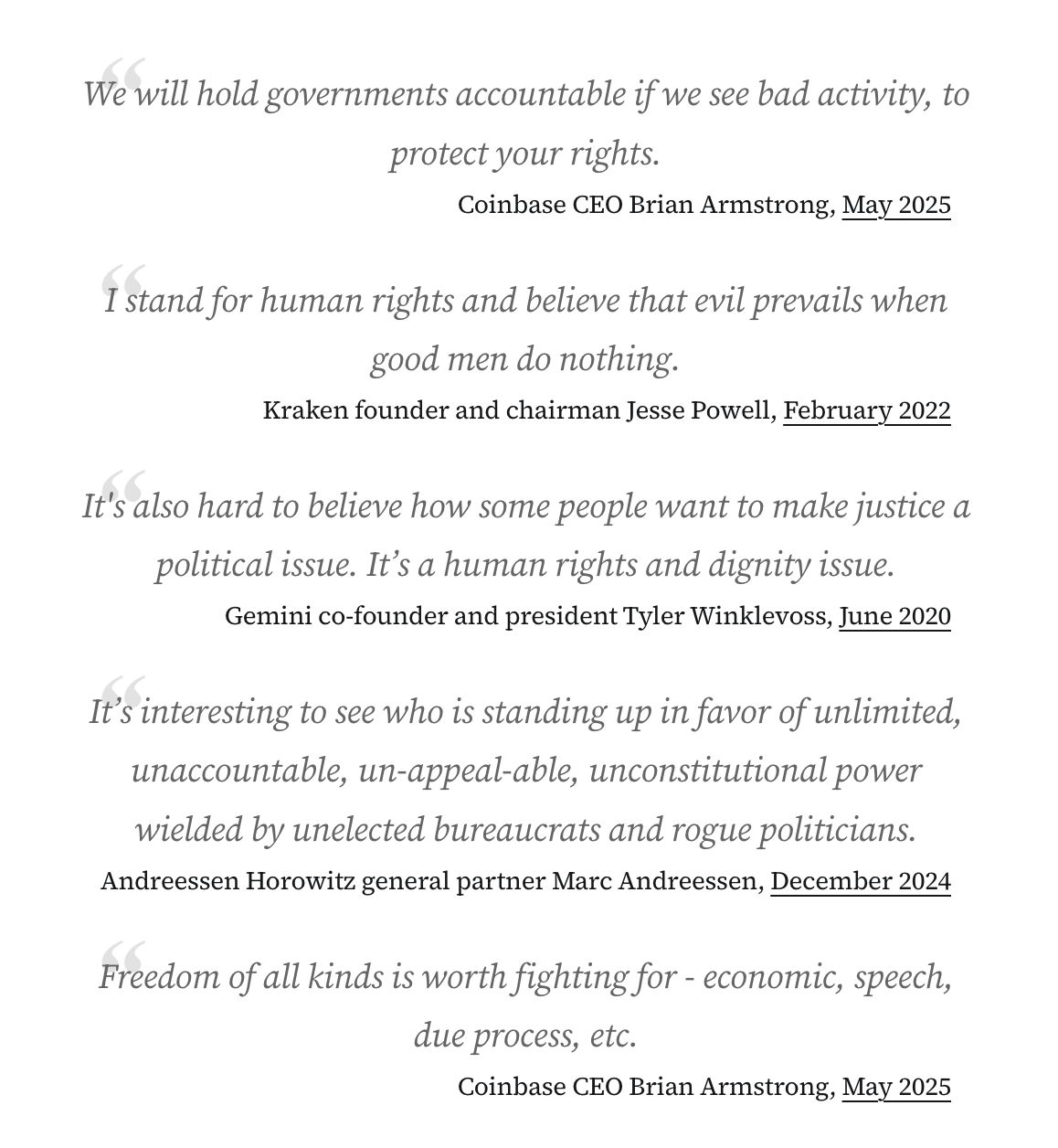
“We will hold governments accountable if we see bad activity, to protect your rights.” Coinbase CEO Brian Armstrong, May 2025
“I stand for human rights and believe that evil prevails when good men do nothing.” Kraken founder and chairman Jesse Powell, February 2022
“It's also hard to believe how some people want to make justice a political issue. It’s a human rights and dignity issue.” Gemini co-founder and president Tyler Winklevoss, June 2020
“It’s interesting to see who is standing up in favor of unlimited, unaccountable, un-appeal-able, unconstitutional power wielded by unelected bureaucrats and rogue politicians.” Andreessen Horowitz general partner Marc Andreessen, December 2024
“Freedom of all kinds is worth fighting for - economic, speech, due process, etc.” Coinbase CEO Brian Armstrong, May 202
“We will hold governments accountable if we see bad activity, to protect your rights.” Coinbase CEO Brian Armstrong, May 2025 “I stand for human rights and believe that evil prevails when good men do nothing.” Kraken founder and chairman Jesse Powell, February 2022 “It's also hard to believe how some people want to make justice a political issue. It’s a human rights and dignity issue.” Gemini co-founder and president Tyler Winklevoss, June 2020 “It’s interesting to see who is standing up in favor of unlimited, unaccountable, un-appeal-able, unconstitutional power wielded by unelected bureaucrats and rogue politicians.” Andreessen Horowitz general partner Marc Andreessen, December 2024 “Freedom of all kinds is worth fighting for - economic, speech, due process, etc.” Coinbase CEO Brian Armstrong, May 202
For years, crypto executives have touted cryptocurrency’s supposed anti-authoritarian and humanitarian credentials — whether to fend off regulators or convince the public that crypto has viable use cases beyond speculation. The technology is necessary and good, they claim, because it could support dissidents living under authoritarian regimes, help persecuted groups escape their oppressors, shield people from surveillance, or somehow inherently protect citizens from government overreach. Many of them spent years posting piously about the importance of due process and protection from abuses of power, or shared quotes from Martin Luther King Jr. and Frederick Douglass about freedom.