Discussion
Loading...

Post

  • About
  • Code of conduct
  • Privacy
  • About Bonfire
Dr. John Barentine FRAS
@JohnBarentine@scicomm.xyz  ·  activity timestamp last week

A @Nature paper published today argues that "Satellite megaconstellations will threaten space-based astronomy" https://www.nature.com/articles/s41586-025-09759-5

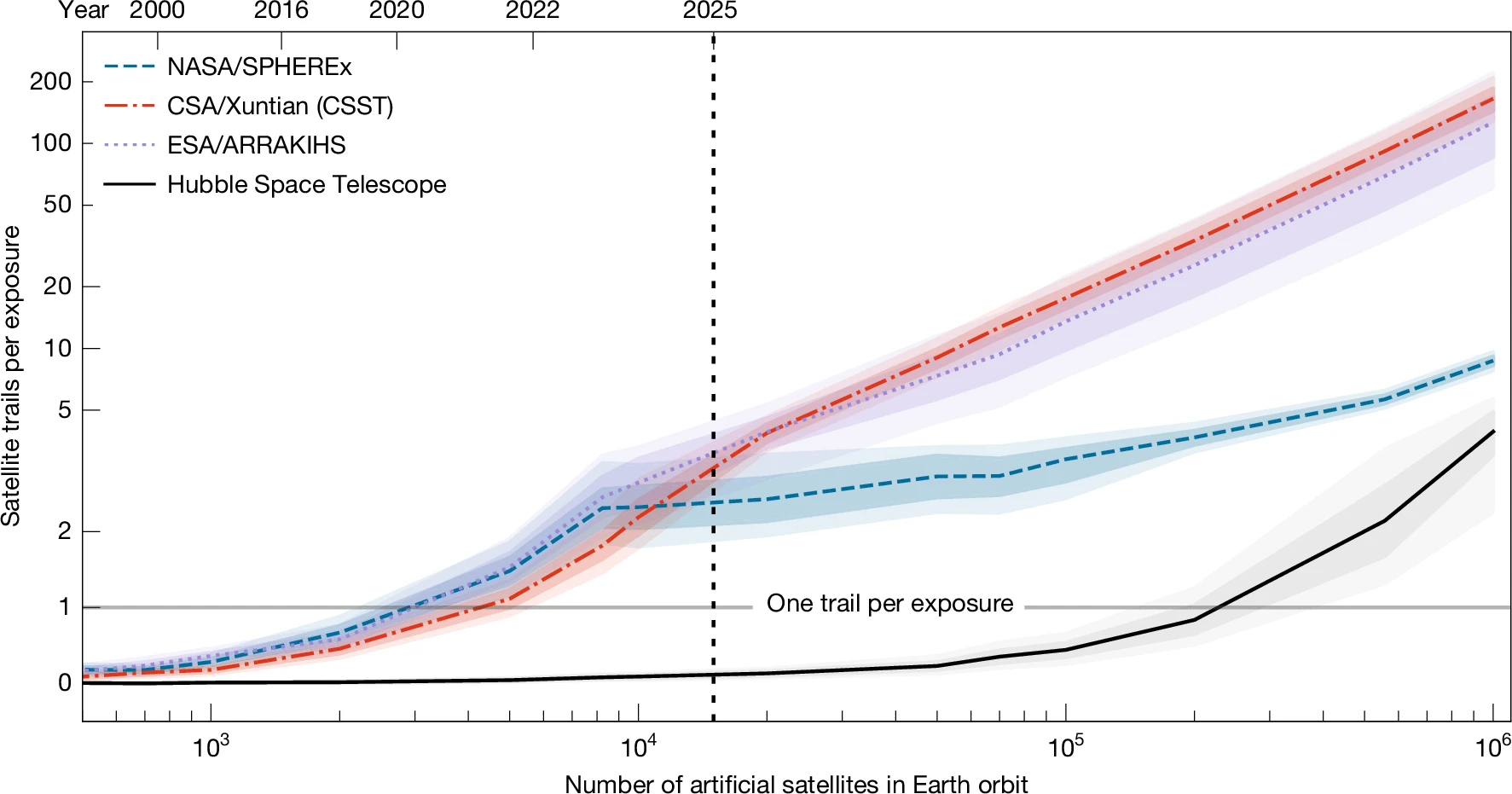
Here's the punchline of the paper: satellites could be a problem even for orbiting space telescopes, but the impact depends on how many are launched. "Our results show that if these constellations are completed, one-third of the images of the Hubble Space Telescope will be contaminated, while the SPHEREx (Spectro-Photometer for the History of the Universe, Epoch of Reionization and Ices Explorer), ARRAKIHS (Analysis of Resolved Remnants of Accreted galaxies as a Key Instrument for Halo Surveys) and Xuntian space telescopes will have more than 96% of +0.3 their exposures affected, with 5.6^+0.3_−0.3, 69^+21_−22, and 92^+11_−10 trails per exposure, respectively, with an average surface brightness of μ = 19 ± 2 mag arcsec−2."
#Astronomy #Satellites #Megaconstellations #SpaceTelescope

The average number of satellite trails visible in each exposure is shown in relation to both the number of artificial satellites orbiting Earth (lower x axis) and epoch (upper x axis). Blue, SPHEREx; red, Xuntian; purple, ARRAKIHS; black, Hubble Space Telescope. Contours represent the 95% confidence levels for the mean number of trails. Horizontal solid line indicates one trail per exposure critical contamination level; vertical dotted line marks the current number of active and inactive satellites in orbit (15,000 as of March 2025).
  • Copy link
  • Flag this post
  • Block
Dr. John Barentine FRAS
@JohnBarentine@scicomm.xyz replied  ·  activity timestamp last week

This paper picked up a lot of media coverage today, including:

@Nature News & Views: https://nature.com/articles/d41586-025-03725-x

@newscientist: https://www.newscientist.com/article/2506858-planned-satellite-launches-could-ruin-hubble-space-telescope-images/

@financialtimes: https://www.ft.com/content/7d4571df-2c08-4355-86b4-053f69d6890f

@reuters: https://www.reuters.com/science/nasa-study-shows-how-satellite-light-pollution-hinders-space-telescopes-2025-12-03/

@cbcnews: https://www.cbc.ca/news/science/satellite-constellations-space-based-astronomy-9.7000454

@SciAm: https://www.scientificamerican.com/article/satellite-megaconstellations-are-now-threatening-telescopes-in-space/

@TheEconomist: https://www.economist.com/science-and-technology/2025/12/03/surging-satellite-numbers-threaten-to-dazzle-even-space-telescopes

@arstechnica: https://arstechnica.com/science/2025/12/planned-satellite-constellations-may-swamp-future-orbiting-telescopes/

Ars Technica

Planned satellite constellations may swamp future orbiting telescopes

Planned orbital observatories would see satellites cross nearly all of their images.
The Economist

Surging satellite numbers threaten to dazzle even space telescopes

Low-flying satellites can ruin astronomical observations

Satellite boom obscures view of distant galaxies

Light pollution from growing number of spacecraft is degrading images from space telescopes
New Scientist

Planned satellite launches could ruin Hubble Space Telescope images

More than half a million satellites are planned to launch by the end of the 2030s, and simulations suggest they will have a severe impact on space-based astronomy
Scientific American

Hubble and Other Space Telescopes Are Now Vulnerable to Satellite Photobombing, Too

Proliferating satellites are beginning to harm the science work of the beloved Hubble Space Telescope and other observatories
  • Copy link
  • Flag this comment
  • Block
Log in

Bonfire Dinteg Labs

This is a bonfire demo instance for testing purposes. This is not a production site. There are no backups for now. Data, including profiles may be wiped without notice. No service or other guarantees expressed or implied.

Bonfire Dinteg Labs: About · Code of conduct · Privacy ·
Bonfire social · 1.0.0 no JS en
Automatic federation enabled
  • Explore
  • About
  • Code of Conduct
Home
Login