Discussion
Loading...

#Tag

  • About
  • Code of conduct
  • Privacy
  • About Bonfire
Prof. Sam Lawler boosted
Dr. John Barentine FRAS
@JohnBarentine@scicomm.xyz  ·  activity timestamp last week

A @Nature paper published today argues that "Satellite megaconstellations will threaten space-based astronomy" https://www.nature.com/articles/s41586-025-09759-5

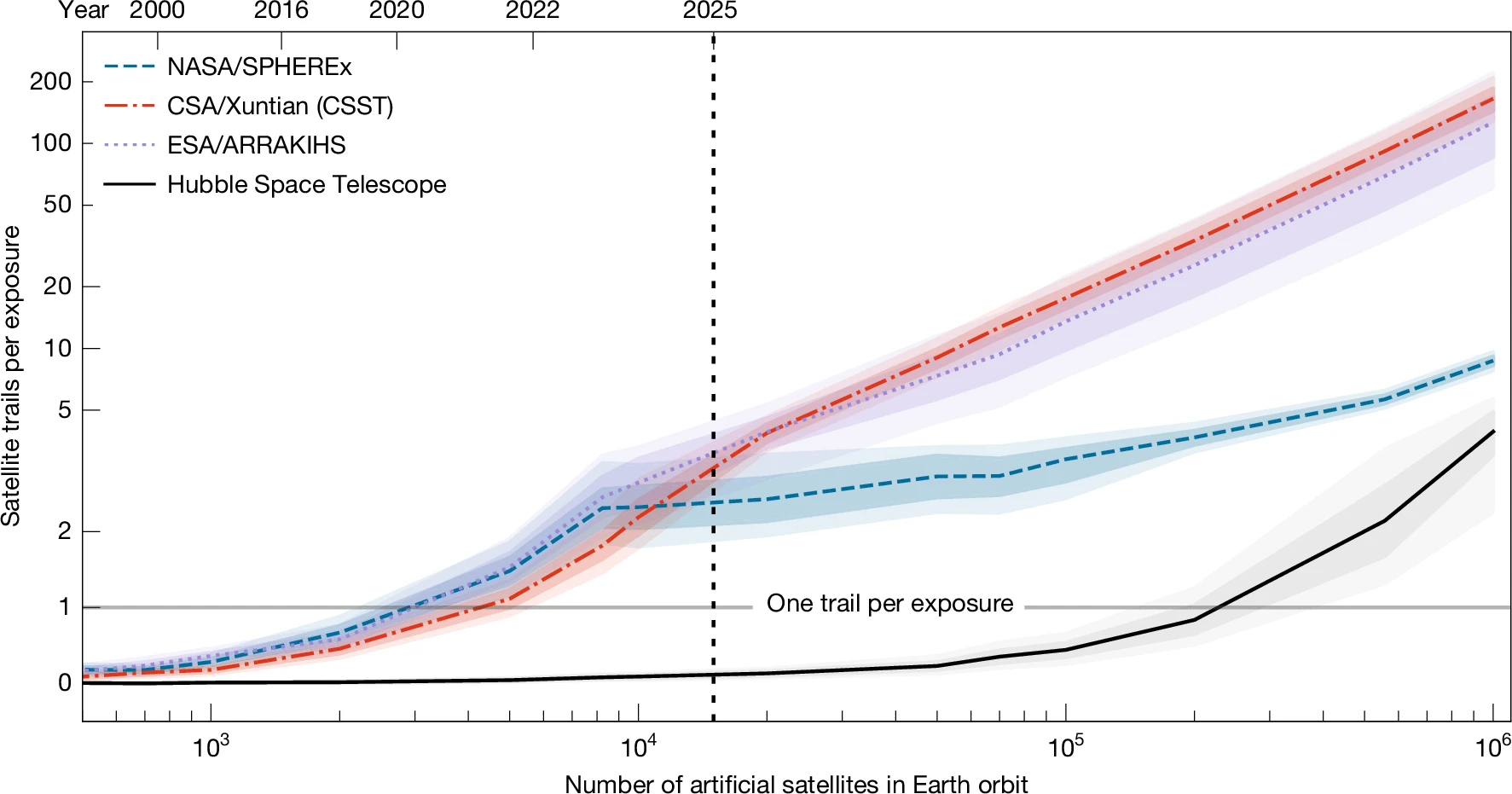
Here's the punchline of the paper: satellites could be a problem even for orbiting space telescopes, but the impact depends on how many are launched. "Our results show that if these constellations are completed, one-third of the images of the Hubble Space Telescope will be contaminated, while the SPHEREx (Spectro-Photometer for the History of the Universe, Epoch of Reionization and Ices Explorer), ARRAKIHS (Analysis of Resolved Remnants of Accreted galaxies as a Key Instrument for Halo Surveys) and Xuntian space telescopes will have more than 96% of +0.3 their exposures affected, with 5.6^+0.3_−0.3, 69^+21_−22, and 92^+11_−10 trails per exposure, respectively, with an average surface brightness of μ = 19 ± 2 mag arcsec−2."
#Astronomy #Satellites #Megaconstellations #SpaceTelescope

The average number of satellite trails visible in each exposure is shown in relation to both the number of artificial satellites orbiting Earth (lower x axis) and epoch (upper x axis). Blue, SPHEREx; red, Xuntian; purple, ARRAKIHS; black, Hubble Space Telescope. Contours represent the 95% confidence levels for the mean number of trails. Horizontal solid line indicates one trail per exposure critical contamination level; vertical dotted line marks the current number of active and inactive satellites in orbit (15,000 as of March 2025).
  • Copy link
  • Flag this post
  • Block
Dr. John Barentine FRAS
@JohnBarentine@scicomm.xyz  ·  activity timestamp last week

A @Nature paper published today argues that "Satellite megaconstellations will threaten space-based astronomy" https://www.nature.com/articles/s41586-025-09759-5

Here's the punchline of the paper: satellites could be a problem even for orbiting space telescopes, but the impact depends on how many are launched. "Our results show that if these constellations are completed, one-third of the images of the Hubble Space Telescope will be contaminated, while the SPHEREx (Spectro-Photometer for the History of the Universe, Epoch of Reionization and Ices Explorer), ARRAKIHS (Analysis of Resolved Remnants of Accreted galaxies as a Key Instrument for Halo Surveys) and Xuntian space telescopes will have more than 96% of +0.3 their exposures affected, with 5.6^+0.3_−0.3, 69^+21_−22, and 92^+11_−10 trails per exposure, respectively, with an average surface brightness of μ = 19 ± 2 mag arcsec−2."

#Astronomy #Satellites #Megaconstellations #SpaceTelescope

The average number of satellite trails visible in each exposure is shown in relation to both the number of artificial satellites orbiting Earth (lower x axis) and epoch (upper x axis). Blue, SPHEREx; red, Xuntian; purple, ARRAKIHS; black, Hubble Space Telescope. Contours represent the 95% confidence levels for the mean number of trails. Horizontal solid line indicates one trail per exposure critical contamination level; vertical dotted line marks the current number of active and inactive satellites in orbit (15,000 as of March 2025).
  • Copy link
  • Flag this post
  • Block
Log in

Bonfire Dinteg Labs

This is a bonfire demo instance for testing purposes. This is not a production site. There are no backups for now. Data, including profiles may be wiped without notice. No service or other guarantees expressed or implied.

Bonfire Dinteg Labs: About · Code of conduct · Privacy ·
Bonfire social · 1.0.0 no JS en
Automatic federation enabled
  • Explore
  • About
  • Code of Conduct
Home
Login